What Does It Mean to Be Baptized in the Holy Spirit
In Christian theology, baptism with the Holy Spirit, as well called baptism in the Holy Spirit or baptism in the Holy Ghost, has been interpreted by different Christian denominations and traditions in a variety of means due to differences in the doctrines of salvation and ecclesiology. Information technology is frequently associated with incorporation into the Christian Church building, the bestowal of spiritual gifts, and empowerment for Christian ministry. Spirit baptism has been variously defined equally part of the sacraments of initiation into the church, equally being synonymous with regeneration, as existence synonymous with Christian perfection that empowers a person for Christian life and service. The term baptism with the Holy Spirit originates in the New Testament, and all Christian traditions take it as a theological concept.
Prior to the 18th century, nearly denominations believed that Christians received the baptism with the Holy Spirit either upon conversion and regeneration or through rites of Christian initiation, such as water baptism and confirmation. Emerging in the mid-18th century, Methodism (inclusive of the holiness movement) affirms the possibility of entire sanctification as a second piece of work of grace, which information technology teaches is the baptism of the Holy Spirit.[1] [2] In the 20th century that saw the spread of Pentecostal churches, which identified baptism of the Holy Spirit with glossolalia, the belief that this is an experience distinct from Christian initiation has come into increasing prominence.[3] [4]
Biblical description [edit]
Sometime Covenant background [edit]
In Christian theology, the work of the Holy Spirit nether the Old Covenant is viewed as less extensive than that under the New Covenant inaugurated on the 24-hour interval of Pentecost.[5] The Spirit was restricted to certain chosen individuals, such as loftier priests and prophets.[vi] Frequently termed the "spirit of prophecy" in rabbinic writings, the Holy Spirit was closely associated with prophecy and divine inspiration.[seven] It was predictable that in the hereafter messianic age God would pour out his spirit upon all of Israel, which would become a nation of prophets.[8] [9]
Canonical gospels [edit]
While the exact phrase "baptism with the Holy Spirit" is non found in the New Testament, two forms of the phrase are plant in the approved gospels using the verb "baptize", from the Greek give-and-take baptizein significant to "immerse" or "plunge".[x] The baptism was spoken about by John the Baptist, who assorted his water baptism for the forgiveness of sins with the baptism of Jesus. In Marker 1 and John one, the Baptist proclaimed that Jesus "will baptize in (the) Holy Spirit"; while in Matthew 3 and Luke iii, he "will baptize with Holy Spirit and burn down".[eleven] [12]
Jesus is considered the first person to receive the baptism with the Holy Spirit.[13] The Holy Spirit descended on Jesus during his baptism and all-powerful him with power.[14] Afterward, Jesus began his ministry and displayed his power by casting out demons, healing the sick, and didactics with potency.[15] [xvi]
Acts of the Apostles [edit]
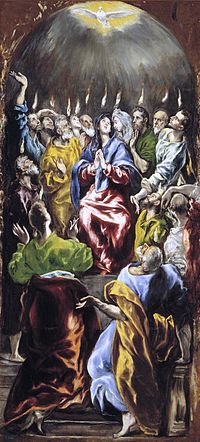
El Greco's depiction of Pentecost, with tongues of fire and a dove representing the Holy Spirit'southward descent (c. 1600)
The phrase "baptized in the Holy Spirit" occurs two times in Acts of the Apostles, first in Acts 1:4–five[17] and second in Acts 11:sixteen.[18] Other terminology is used in Acts to indicate Spirit baptism, such as "filled".[xix] "Baptized in the Spirit" indicates an outward immersion into the reality of the Holy Spirit, while "filled with the Spirit" suggests an internal diffusion. Both terms speak to the totality of receiving the Spirit.[20] The baptism with the Holy Spirit is described in diverse places as the Spirit "poured out upon", "falling upon", "coming upon" people.[21] [22] To "pour out" suggests abundance and reflects John 3:34,[23] "God gives the Spirit without limit". Another expression, "come upon" is related to a statement by Jesus in Luke 24:49, "I am sending the hope of my Father upon y'all. Simply stay in the metropolis until yous are clothed with power from on high". The linguistic communication of "come on" and "clothed with" advise possession by and endowment with the Holy Spirit.[twenty] [24]
The narrative of Acts begins later on Jesus' crucifixion and resurrection. The resurrected Jesus directed his disciples to wait in Jerusalem for the baptism in the Holy Spirit and promised, "you volition receive power when the Holy Spirit has come upon you, and you will be my witnesses in Jerusalem and in all Judea and Samaria, and to the stop of the earth".[25] After his ascension, he was given dominance to pour out the Holy Spirit.[fifteen]
In the New Testament, the messianic expectations found in early on Judaism were fulfilled on the day of Pentecost as recorded in Acts.[26] The Christian community was gathered together in Jerusalem when a audio from sky similar rushing wind was heard and tongues like tongues of flame rested on everyone. They were filled with the Holy Spirit and began to speak in tongues, miraculously praising God in strange languages. A oversupply gathered and was addressed by the Apostle Peter who stated that the occurrence was the fulfillment of the prophecy of Joel 2, "And in the last days it shall be, God declares, that I volition pour out my Spirit on all flesh, and your sons and your daughters shall prophesy". He then explained how the Spirit came to be poured out, recounting Jesus' ministry and passion and and then proclaiming his resurrection and enthronement at the right manus of God. In response, the crowd asked Peter what they should practice. He responded that they should repent and exist baptized for the forgiveness of sins in club to receive the gift of the Holy Spirit. Peter finished his speech stating that the promise "is for you lot and for your children and for all who are far off, everyone whom the Lord our God calls to himself".[6]
Baptism in the Holy Spirit occurs elsewhere in Acts. The gospel had been proclaimed in Samaria and the apostles Peter and John were sent from Jerusalem. The new believers had been baptized in water, but the Holy Spirit had not nevertheless fallen on them. The Samaritans received the Holy Spirit when Peter and John laid their hands on them.[27] The Apostle Paul was also filled with the Holy Spirit when Ananias of Damascus laid easily on him, and after Paul was baptized with water.[28]
Subsequently in Acts, Peter preached the gospel to the household of Cornelius the Centurion, a gentile. While he preached, the Holy Spirit fell on the gentiles, and they began to speak in tongues. The Jewish believers with Peter were amazed, and the household was h2o baptized.[29] While the campaigner Paul was in Ephesus, he found disciples there and discovered that they did not know of the existence of the Holy Spirit and had merely received John the Baptist's baptism. After baptizing them in Jesus' proper name, Paul laid his hands on them, and they began to speak in tongues and prophesy.[30]
History [edit]
Early Christianity [edit]
In the early Church, the laying on of easily on the newly baptized to impart the gift of the Holy Spirit was the origin of the sacrament of confirmation. In the Eastern church, confirmation connected to be historic immediately after water baptism. The two rites were separated in the Western church.[31] Co-ordinate to Pentecostal historian H. Vinson Synan, "the basic premise of Pentecostalism, that ane may receive later effusions of the Spirit afterward initiation/conversion, tin be clearly traced in Christian history to the beginnings of the rite of confirmation in the Western churches".[32]
Reformation era and Puritanism (16th and 17th centuries) [edit]
Huldrych Zwingli, a leading Protestant Reformer in Switzerland, taught three distinct baptisms: water baptism, educational activity baptism (having been educated about the Christian faith) and Spirit baptism. While full baptism included all three, Zwingli emphasized that the external baptisms of water and pedagogy could non provide conservancy. The inner baptism of the Spirit alone could save because information technology conferred faith. According to Zwingli, the 3 baptisms could exist given separately; Spirit baptism could occur offset or last in the sequence.[33]
Many Puritans believed that the conversion experience was followed by a later and distinct experience of the Holy Spirit. This feel was characterized by receiving assurance of 1's salvation. English Puritan Thomas Goodwin equated this experience with the baptism in the Holy Spirit and the "seal of the Spirit" referenced in Ephesians ane.[34]
Early Methodism and the Holiness Movement (18th and 19th centuries) [edit]

Synan traces the influence of Cosmic and Anglican mystical traditions on John Wesley'due south doctrine of Christian perfection or entire sanctification, from which Pentecostal beliefs on Spirit baptism developed.[36] Furthermore, theologian James Dunn notes early Methodist beliefs tin be directly linked to Puritan pedagogy on the Holy Spirit.[34]
Wesley taught that while the new birth was the start of the Christian life, just "inbred sin" remained and must exist removed through Christian perfection, which he stated had instantaneous and gradual aspects.[37] [36] John Fletcher, Wesley's designated successor, called Christian perfection a "baptism in the Holy Spirit".[1] [38] On the subject, Fletcher wrote:
Lastly: if we will attain the full power of godliness, and exist peaceable as the Prince of Peace, and merciful as our heavenly Father, let u.s.a. proceed to the perfection and celebrity of Christianity; allow us enter the full dispensation of the Spirit. Till we alive in the pentecostal glory of the Church: till we are baptized with the Holy Ghost: till the Spirit of burning and the fire of Divine love have melted united states of america down, and nosotros have been truly cast into the softest mould of the Gospel: till we can say with St. Paul, "We accept received the Spirit of love, of power, and of a audio heed;" till then nosotros shall be carnal rather than spiritual believers.[39]
In mid-19th century America, the Wesleyan holiness movement that had adherents both inside and outside mainline Methodism began to teach that entire sanctification was less a process and emphasized the instantaneous attribute of Wesley'south doctrine, which i entered into by religion at a definite moment in fourth dimension.[twoscore] This second blessing (or second work of grace), as it was commonly chosen, immune Christians to be freed from the power of sin. Among adherents of the holiness movement, baptism in the Holy Spirit was synonymous with second blessing sanctification.[36]
John Wesley'due south Checks to Antinomianism later on became a standard for Pentecostally-inclined holiness teachers.
Keswick college life movement (19th century) [edit]
Later on his conversion in 1821, Presbyterian minister and revivalist Charles Grandison Finney experienced what he chosen "baptism in the Holy Spirit" accompanied by "unutterable gushings" of praise.[41] Finney and other Reformed writers, known every bit Oberlin perfectionists, agreed that there was a life altering feel after conversion, just dissimilar their Wesleyan holiness counterparts, they conceived of it every bit an ongoing process enabling believers to devote themselves wholly to Christ's service. Similarly, the English Higher Life move taught that the 2d blessing was an "enduement of ability". According to this view, Spirit baptism gave Christians the ability to exist witnesses for the gospel and to perform Christian service. Wesleyan teachers emphasized purity while Oberlin and higher life advocates stressed ability as the defining consequence of Spirit baptism.[36]
20th century [edit]
In the early 1890s, R.C. Horner, a Canadian holiness evangelist, introduced a theological distinction that would be of import for the development of Pentecostalism. He argued in his books Pentecost (1891) and Bible Doctrines (1909) that the baptism in the Holy Spirit was not synonymous with the second blessing just was actually a third piece of work of grace subsequent to salvation and sanctification that empowered the believer for service.[42] Charles Fox Parham would build on this doctrinal foundation when he identified speaking in tongues as the Bible bear witness of Spirit baptism.[43]
Views [edit]

The diverse views on Spirit-baptism held among Christian traditions can be categorized into iii master groups. These are baptism with the Spirit as sacramental initiation (Orthodox and Catholic churches), regeneration (Reformed tradition), and empowerment for witness and vocation (Pentecostals and charismatics).[44]
Sacramental initiation [edit]
Eastern Orthodoxy [edit]
Eastern Orthodox Churches believe that baptism in the Holy Spirit is conferred with water baptism. The individual is anointed with oil (chrism) immediately after baptism. According to Cyril of Jerusalem:
This holy ointment is no more simple ointment, nor (so to say) common, after the invocation, but the gift of Christ; and by the presence of His Godhead, it causes in united states of america the Holy Ghost. It is symbolically applied to thy brow and thy other senses and while thy torso is anointed with visible ointment, thy soul is sanctified by the Holy and life-giving Spirit.[45]
Catholicism [edit]
The Cosmic Church teaches that baptism, confirmation, and the Eucharist—the sacraments of Christian initiation—lay the foundations of the Christian life.[46] The Christian life is based on baptism. It is "the gateway to life in the Spirit" and "signifies and actually brings about the birth of h2o and the Spirit".[47] The post-baptismal anointing (Chrismation in the Eastern churches) signifies the souvenir of the Holy Spirit and announces a second anointing to be conferred later on in confirmation that completes the baptismal anointing.[48]
Confirmation, then, is necessary for the completion of baptismal grace.[49] When confirmed, Catholics receive the "special outpouring of the Holy Spirit as in one case granted to the apostles on the day of Pentecost".[fifty] For the confirmand information technology increases the seven gifts of the Holy Spirit (wisdom, understanding, counsel, fortitude, knowledge, piety, and fear of the Lord), unites more fully to Christ and the Church, and gives strength to confess Christ and defend the faith.[51] The rite of confirmation orients toward mission, and many liturgical texts remind the initiate that the gift of the Holy Spirit should be used for service to the church building and the world.[52]
Those in the charismatic movement, including the Cosmic Charismatic Renewal, teach an experiential baptism of the Holy Spirit similar to Pentecostals, defining it as the "sovereign action of God, which unremarkably occurs when someone with a disposition of surrender and docility, prays for a fresh outpouring of the Holy Spirit in his or her life."[53] The consensus of Cosmic theologians teach that this "baptism in the Holy Spirit unleashes the Holy Spirit that is already nowadays within us, past revitalizing the graces we received in the sacrament of Baptism."[53] At the same time, "Baptism in the Spirit doesn't only re-ignite the graces already given to Christians through the Sacraments – it'southward also a new, fresh experience of the Holy Spirit which equips and inspires the individual for service, for mission, for discipleship and for life."[54] Rev. Brenton Cordeiro teaches that those who have received Baptism with the Holy Spirit "testify that the experience brought them to a new awareness of the reality and presence of Jesus Christ in their lives [too as] a new hunger for the Word of God, the Sacraments and were filled with a renewed desire for holiness."[53]
Irvingism [edit]
The New Churchly Church, an Irvingian Church, believes that baptism in the Holy Spirit is a second pace after the Holy Baptism with H2o. It likewise referred to as the Holy Sealing. Information technology is a sacrament through which the believer, through the laying on of hands and the prayer of an apostle, receives the souvenir of the Holy Spirit. The decease out of water and spirit, which was begun in the Holy Baptism with Water, is completed through the Holy Sealing. [55]
Regeneration [edit]
The master position on Spirit baptism among the Reformed churches, dispensationalists, and many Baptists is that the baptism with the Holy Spirit occurs simultaneously with regeneration, when those who have faith in Jesus Christ receive the Holy Spirit and are incorporated into the trunk of Christ.[56] [57] [58] [59]
Sanctification [edit]
Methodism (inclusive of the holiness movement) [edit]

Within Methodism (inclusive of the holiness motility), baptism with the Holy Spirit has often been linked to living a sanctified life. The United Methodist Church has a sacramental view of baptism and confirmation, in which the believer receives and is strengthened by the Holy Spirit, respectively.[60] At the same time, the United Methodist Confession of Faith affirms Wesley's doctrine of Christian perfection (likewise known as entire sanctification), the 2d piece of work of grace:[61]
Unabridged sanctification is a state of perfect honey, righteousness and true holiness which every regenerate laic may obtain past existence delivered from the power of sin, by loving God with all the center, soul, mind and strength, and by loving ane'southward neighbor equally one's self. Through organized religion in Jesus Christ this gracious gift may be received in this life both gradually and instantaneously, and should exist sought earnestly by every child of God.[61]
In holiness movement within mainline Methodism and exterior of it, entire sanctification is emphasized as a definite experience linked to baptism with the Holy Spirit:[1] [ii]
2.9 ENTIRE SANCTIFICATION As all justified believers are sanctified in Christ (I Cor. 1:2; 1:30), and so all may be sanctified by Christ (Eph five:25, 26; Heb. xiii:12). Entire sanctification follows regeneration as circumcision follows nascence. It is to enable u.s.a. to "Love the Lord thy God with all thine heart" (Deut. thirty:half dozen). By this circumcision " made without hands", the "torso of the sins of the flesh" is put off (Col. two:xi). Love is made perfect (I John 4:17); Holiness is perfected (II Cor. 7:1).
2.ix.i Human relationship to Regeneration. Unabridged sanctification is subsequent to regeneration (John 17:9 -17) and is effected by the baptism of the Holy Spirit (Luke 3:sixteen. 17: I Pet. i:ii; Rom 15:16). Information technology is for all believers (John 17:20; I Thess. 4:ii, 7; v:23, 24), and is an instantaneous experience, received by faith (Acts 2:i-4; xv:eight, 9). Information technology cleanses the heart of the recipient from all sin (I John 1:7, 9; Acts 15:8, 9), sets him apart and endows him with power for the achievement of all to which he is called (Luke 24:49; Acts 1:eight).
2.ix.2 Prove of the Experience. Those who teach that some special phenomena such as speaking with unknown tongues constitutes a witness to the Baptism with the Spirit expose themselves and their hearers to peril of dangerous fanaticism. Perhaps no wiser counsel has been given on this affair then that of John Wesley who wrote long before the modern "tongues" move appeared: "The grounds of a thousand mistakes is the not considering, securely that love is the highest gift of God - humble, gentle, patient love - that all visions, revelation, manifestations whatsoever are little things compared to love. It were well you should be thoroughly sensible of this. The heaven of heavens is honey. In that location is nada higher in faith; in that location is in issue, nothing else. If you look for anything simply more dearest you are looking broad of the mark, you are getting out of the imperial manner. And when yous are request others, "Accept you received this or that blessing," if you mean annihilation but more dearest you lot, you hateful wrong; you are leading them out of the mode, and putting them upon a false scent. Settle it and so in your middle, that from the moment God has saved yous from all sin, yous are to aim at nothing but more of that beloved described in the thirteenth chapter of Kickoff Corinthians. You can go no higher than this till y'all are carried into Abraham'due south bosom." ―Doctrine, Pilgrim Holiness Church[2]
According to the Articles of Organized religion of the Church of the Nazarene, sanctification is a work of God later regeneration "which transforms believers into the likeness of Christ" and is made possible past "initial sanctification" (which occurs simultaneously with regeneration and justification), unabridged sanctification, and "the continued perfecting work of the Holy Spirit culminating in glorification".[62] Entire sanctification (equally opposed to initial sanctification) is an act of God in which a believer is made free from original sin and able to devote him or herself entirely to God:
It is wrought by the baptism with or infilling of the Holy Spirit, and comprehends in 1 experience the cleansing of the heart from sin and the abiding, indwelling presence of the Holy Spirit, empowering the believer for life and service.[62]
As Baptism with the Holy Spirit is synonymous with Unabridged Sanctification in Methodism, some Methodist connexions who have non allowed for the charismatic motility, such as the Immanuel Missionary Church, condemn the Pentecostal doctrine:[63]
The modernistic and then-chosen gift of tongues, is unscriptural and cannot be taken as a sign of the Baptism of the Holy Ghost. Jesus said, "An evil and cheating generation seeketh after sin." Therefore, to concord or teach that speaking in an unknown natural language is the evidence of a piece of work of grace in the center, is to Biblical for the following reasons:
- The give-and-take "unknown" is not in the original Greek, and the word "tongue" comes from the Greek discussion "glossa," significant language.
- None of the gifts can be taken every bit a witness of the Spirit's baptism (I Corinthians 12).
- Paul exhorted that all speaking in the church should exist to edification. Therefore such speaking that does non edify will not exist permitted in our places of worship. —Full general Standards, Immanuel Missionary Church[63]
Empowerment [edit]
Classical Pentecostalism [edit]
In classical Pentecostalism, the baptism with the Holy Spirit is understood to be a separate and singled-out experience occurring one-time after regeneration. Influenced by the Holiness move, baptism with the Holy Spirit was regarded by the first Pentecostals as being the tertiary work of grace, following the new nascency (first work of grace) and entire sanctification (2nd work of grace).[three] [64] Baptism with the Holy Spirit is an empowering feel, equipping Spirit-filled believers for witness and ministry building.[21] Extending from this is the conventionalities that all the spiritual gifts mentioned in the New Testament are to be sought and exercised to build up the church.[4] Pentecostals believe that Spirit baptism volition be accompanied past the physical evidence of speaking in tongues (glossolalia).[65]
According to Pentecostal biblical interpretation, the Gospel of John 20:22 shows that the disciples of Jesus were already built-in over again before the Holy Spirit brutal at Pentecost. They so cite biblical examples in the Book of Acts 2, 8, 10, and 19 to show that information technology was mutual in the New Testament for Spirit baptism to occur after conversion. In following the biblical pattern, they contend, Christians today should as well pray for this baptism which results in greater power for ministry and witness.[66]
On the discipline of Spirit baptism, Donald Gee wrote of the Christians on the Solar day of Pentecost:
With them information technology was not mere intellectual assent to some article in a creed defining an orthodox doctrine apropos the Holy Spirit. Neither were they satisfied to acquiescence to a vague idea that in some indefinite manner the Holy Spirit had been imparted to them upon conversion. They gladly and thankfully recognized His gracious operations in their regeneration and sanctification, simply their own personal reception of the Holy Spirit was an intensely vivid experience. They knew when He came, where He came, and how he came. Nothing reveals this more than Paul's searching question to sure disciples whom he immediately sensed to be spiritually lacking in a vital office of their Christian inheritance—'Have ye received the Holy Ghost?' (Acts nineteen:2). The challenge was to feel, not to doctrine. How significant! An Ephesian 'Pentecost' rapidly rectified their shortcoming, and it was an experience as vivid as all the residue had received—'They spake with tongues and prophesied.'[67]
In Pentecostal experience, Spirit baptism tin be quite dramatic, as shown by William Durham's account of his Spirit baptism:
I was overcome by the mighty fulness of power and went downward under information technology. For iii hours He wrought wonderfully in me. My body was worked in sections, a section at a time. And even the peel on my face up was jerked and shaken, and finally I felt my lower jaw begin to quiver in a strange style. This continued for some little fourth dimension, when finally my throat began to overstate and I felt my vocal organs being, equally it were, drawn into a unlike shape. O how strange and wonderful information technology was! and how blessed it was to be thus in the hands of God. And last of all I felt my natural language begin to move and my lips to produce strange sounds which did not originate in my mind.[68]

The Apostolic Organized religion Mission on Azusa Street, at present considered to be the birthplace of Pentecostalism.
In some accounts of Spirit baptism, Pentecostals report receiving visions, such as the account of Lucy Leatherman, an Azusa Street participant:
While seeking for the Baptism with the Holy Ghost in Los Angeles, after Sister Ferrell [sic] laid hands on me I praised and praised God and saw my Savior in the heavens. And as I praised, I came closer and closer and I was and so small. Past and by I swept into the wound in His side, and He was not simply in me but I in Him, and at that place I found that rest that passeth all understanding, and He said to me, you are in the bosom of the Father. He said I was clothed upon and in the secret place of the Most High. Just I said, Father, I want the gift of the Holy Ghost, and the heavens opened and I was overshadowed, and such power came upon me and went through me. He said, Praise Me, and when I did, angels came and ministered unto me. I was passive in His hands working on my song cords, and I realized they were loosing me. I began to praise Him in an unknown language.[69]
Charismatic Movement [edit]
The charismatic movement is an interdenominational revival that has afflicted the mainstream denominations of Christianity, including Lutheranism, Catholicism, Moravianism, Anglicanism, Methodism, and Reformed Christianity, among others.[70] [71] [72] They are distinguished from Pentecostals because they tend to allow for differing viewpoints on whether Spirit baptism is subsequent to conversion and whether tongues is always a sign of receiving the baptism.[4]
The Catholic Charismatic Renewal believes that there is a further experience of empowerment with the Holy Spirit.[73] The Rev. Brenton Cordeiro states that Baptism with the Holy Spirit is the "sovereign activeness of God, which unremarkably occurs when someone with a disposition of surrender and docility, prays for a fresh outpouring of the Holy Spirit in his or her life."[53] Equally stated by Rev. Fr. Raniero Cantalamessa, "baptism in the Spirit is non a sacrament, but it is related to a sacrament…to the sacraments of Christian initiation. The baptism in the Spirit makes real and in a fashion renews Christian initiation".[74] The consensus of Catholic theologians teach that "baptism in the Holy Spirit unleashes the Holy Spirit that is already present within u.s.a., by revitalizing the graces we received in the sacrament of Baptism."[53] At the same time, "Baptism in the Spirit doesn't but re-ignite the graces already given to Christians through the Sacraments – it'south also a new, fresh experience of the Holy Spirit which equips and inspires the private for service, for mission, for discipleship and for life."[54] Rev. Brenton Cordeiro teaches that those who have received Baptism with the Holy Spirit "bear witness that the experience brought them to a new sensation of the reality and presence of Jesus Christ in their lives [also as] a new hunger for the Word of God, the Sacraments and were filled with a renewed want for holiness."[53]
Neo-charismatic movement [edit]
During the 1980s, another renewal movement emerged called the "3rd Wave of the Holy Spirit" (the commencement moving ridge was Pentecostalism and the 2nd wave was the charismatic movement). Third wave charismatics stress that the preaching of the gospel, post-obit the New Attestation pattern, should be accompanied past "signs, wonders, and miracles". They believe that all Christians are baptized with the Holy Spirit at conversion, and prefer to call subsequent experiences equally "filling" with the Holy Spirit. John Wimber and the Vineyard churches are most prominently associated with this label.[four]
Mormonism [edit]
In the Latter Day Saint movement, the "baptism of burn and of the Holy Ghost" refers to the experience of one who undergoes the ordinance of confirmation with the laying on of easily to receive the gift of the Holy Ghost. It follows baptism in water and is essential to salvation.[75] The gift of the Holy Ghost is the privilege of receiving inspiration, divine manifestations, direction, spiritual gifts, and other blessings from the Holy Spirit (see Gifts of the Spirit in Mormonism).[76] It begins the lifetime procedure of sanctification.[77]
Bible references [edit]
- Matthew 3:11: …He will baptize yous with the Holy Spirit…"
- Marking 1:8: …He will cognominate you with the Holy Spirit…"
- Luke 3:16: "He will baptize you with the Holy Spirit…"
- Luke 3:22: "…and the Holy Spirit descended upon him in bodily form like a pigeon."
- Luke 11:xiii: "…how much more than will the heavenly Male parent requite the Holy Spirit to those who ask him!"
- Luke 24:49: …stay hither in the city until you lot have been clothed with power from on high." (see fulfillment in Acts 2).
- John ane:33: …the 1 who baptizes with the Holy Spirit."
- Acts 1:4–five: …the Promise of the Father…"; …yous volition be baptized with the Holy Spirit…"
- Acts 2:ane–4: "All of them were filled with the Holy Spirit and began to speak in other languages…"
- Acts 2:14–xviii: …I volition cascade out my Spirit…" (quoting Joel 2:28–29).
- Acts iv:31: …they were all filled with the Holy Spirit…"
- Acts viii:xiv–17: …prayed for them that they might receive the Holy Spirit…"; …as yet the Spirit had not yet come upon whatever of them…"; …they received the Holy Spirit…"; …the Spirit was given through the laying on of the apostles' hands…."
- Acts 9:17: …Jesus…has sent me…that you may…be filled with the Holy Spirit."
- Acts ten:44–48: "The Holy Spirit fell upon all who heard the discussion…"; …the gift of the Holy Spirit had been poured out…"; …people who have received the Holy Spirit…"
- Acts 11:fifteen–sixteen: "…the Spirit fell upon them…"; …you volition be baptized with the Holy Spirit…"
- Acts 15:8: "God…testified to them by giving them the Holy Spirit, but as he did to u.s."
- Acts nineteen:1–6: "Did y'all receive the Holy Spirit…?"; …the Holy Spirit came upon them, and they spoke in tongues and prophesied…"
- 1 Cor 12:13: "For in one Spirit we were all baptized into one body--Jews or Greeks, slaves or gratuitous..."
- Gal 3:2: "Did you receive the Spirit...past believing what you heard?"
- Eph 1:13: "…marked with the seal of the promised Holy Spirit"
See also [edit]
- Baptism by fire
- Consolamentum
- Protestant theologies
- Spirit possession
Notes [edit]
- ^ a b c "Guidelines: The UMC and the Charismatic Motion". The United Methodist Church building. 2012. Retrieved 31 July 2019.
The Methodists were besides showtime to coin the phrase baptism of the Holy Spirit equally applied to a second and sanctifying grace (feel) of God. (Cf. John Fletcher of Madeley, Methodism'south earliest formal theologian.) The Methodists meant by their "baptism" something unlike from the Pentecostals, but the view that this is an experience of grace separate from and afterward salvation was the same.
- ^ a b c "Doctrine". Pilgrim Holiness Church building of New York, Inc. xv Dec 2000. Retrieved 31 May 2018.
- ^ a b The W Tennessee Historical Society Papers - Result 56. West Tennessee Historical Club. 2002. p. 41.
Seymour's holiness background suggests that Pentecostalism had roots in the holiness movement of the late nineteenth century. The holiness movement embraced the Wesleyan doctrine of "sanctification" or the second work of grace, subsequent to conversion. Pentecostalism added a third work of grace, called the baptism of the Holy Ghost, which is often accompanied past glossolalia.
- ^ a b c d Grudem 1994, pp. 763–64.
- ^ Grudem 1994, p. 770.
- ^ a b Carson & Cerrito 2003, pp. 100–03.
- ^ Greenspahn 1989, p. 37.
- ^ Wurzburger 2007, p. 580.
- ^ "Holy Spirit", Jewish Encyclopedia (1906). Accessed March 15, 2012.
- ^ Catechism of the Catholic Church, paragraph 1214.
- ^ McDonnell & Montague 1991, p. 4.
- ^ Mt iii:11 and Lk 3:16
- ^ McDonnell & Montague 1991, p. 7.
- ^ Mk 1:9–11
- ^ a b Grudem 1994, p. 771.
- ^ Lk 4:16–44
- ^ "Bible Gateway passage: Acts 1:four-five - New King James Version". Bible Gateway.
- ^ "Bible Gateway passage: Acts 11:16 - New Rex James Version". Bible Gateway.
- ^ Acts 2:4
- ^ a b "Baptism in the Holy Spirit", New International Dictionary of Pentecostal and Charismatic Movements.
- ^ a b Duffield & Van Carve 2008, p. 312.
- ^ See Acts two:17–xviii, Acts 2:33, Acts eight:16, Acts 10:44, Acts 1:8,Acts 19:vi
- ^ "Bible Gateway passage: John 3:34 - New King James Version". Bible Gateway.
- ^ Lk 24:49
- ^ Acts 1:viii
- ^ Acts 2:one–41
- ^ Acts eight:14–xviii
- ^ Acts nine:17–xix
- ^ Acts 10:44–48
- ^ Acts nineteen:1–7
- ^ Catechism of the Cosmic Church, paragraphs 1288–1292.
- ^ Synan 1997, p. x.
- ^ Bromiley 1978, p. 278.
- ^ a b Dunn 1977, p. 1.
- ^ Gibson, James. "Wesleyan Heritage Series: Entire Sanctification". S Georgia Confessing Association. Archived from the original on 29 May 2018. Retrieved xxx May 2018.
- ^ a b c d Wacker 2001, p. 2.
- ^ Knight, Henry H. (2014). Anticipating Heaven Below: Optimism of Grace from Wesley to the Pentecostals. Wipf and Stock Publishers. p. 56. ISBN9781630871253.
Wesley insisted, especially in his later on writings, that Christian perfection is both instantaneous and gradual. In 1767 he wrote "Equally to the style, I believe this perfection is always wrought in the soul by a simple act of faith; consequently in an instant. Only I believe a gradual work, both preceding and following that instant.
- ^ Synan 1997, pp. 6–seven.
- ^ Fletcher 1833, p. 356.
- ^ Winn, Christian T. Collins (2007). From the Margins: A Celebration of the Theological Work of Donald Due west. Dayton. Wipf and Stock Publishers. p. 115. ISBN9781630878320.
In addition to these separate denominational groupings, i needs to give attention to the large pockets of the Holiness move that take remained within the United Methodist Church building. The most influential of these would be the circles dominated by Asbury College and Asbury Theological Seminary (both in Wilmore, KY), but one could speak of other colleges, innumerable local campmeetings, the vestiges of various local Holiness associations, contained Holiness oriented missionary societies and the like that have had great touch within United Methodism. A like pattern would be in England with the role of Cliff Higher inside Methodism in that context.
- ^ Synan 1997, pp. fourteen–15.
- ^ Synan 1997, p. 50.
- ^ Synan 1997, p. 89.
- ^ Macchia 2006, p. 64.
- ^ Cyril 1986, p. 65.
- ^ Catechism of the Catholic Church, paragraph 1212.
- ^ Catechism of the Catholic Church, paragraphs 1213, 1215.
- ^ Catechism of the Catholic Church, paragraphs 1241–1242.
- ^ Canon of the Catholic Church, paragraph 1285.
- ^ Catechism of the Cosmic Church, paragraph 1302.
- ^ Canon of the Cosmic Church, paragraph 1303.
- ^ Carson & Cerrito 2003, pp. 84–92.
- ^ a b c d due east f Cordeiro, Brenton (29 May 2017). "Baptism in the Holy Spirit: Why Every Catholic Should Consider Receiving It". Catholic Link. Retrieved 26 May 2021.
- ^ a b "Baptism in the Holy Spirit". Catholic Charismatic Renewal. Retrieved 26 May 2021.
- ^ "The Canon of the New Apostolic Church - Secition 8.3 Holy Sealing". www.nak.org . Retrieved 2019-03-17 .
- ^ Kaiser 2004, p. 36.
- ^ Pettegrew 1997, pp. 29–46.
- ^ Allison 2012, p. v.
- ^ Vanhetloo 1989, p. 103.
- ^ "By H2o and the Spirit: A United Methodist Understanding of Baptism". The Book of Resolutions of The United Methodist Church. The United Methodist Church. 2008.
- ^ a b Buschart 2009, p. 194.
- ^ a b Articles of Faith of the Church building of the Nararene Archived 2012-03-xi at the Wayback Motorcar, Article 10. Accessed May 21, 2011.
- ^ a b Subject area of the Immanuel Missionary Church. Shoals, Indiana: Immanuel Missionary Church. 1986. p. nine, sixteen-17.
- ^ The Encyclopedia of Christianity. Wm. B. Eerdmans Publishing. 1999. p. 415. ISBN9789004116955.
While in Houston, Texas, where he had moved his headquarters, Parham came into contact with William Seymour (1870-1922), an African-American Baptist-Holiness preacher. Seymour took from Parham the teaching that the baptism of the Holy Spirit was not the blessing of sanctification but rather a 3rd work of grace that was accompanied by the experience of tongues.
- ^ "Introduction", New International Dictionary of Pentecostal and Charismatic Movements.
- ^ Grudem 1994, pp. 764–65.
- ^ Gee, pp. 14–15. sfn error: no target: CITEREFGee (help)
- ^ Jacobsen 2003, p. 20.
- ^ Robeck 2006, p. 182.
- ^ Leo Joseph Suenens (1978). Ecumenism and Charismatic Renewal: Theological and Pastoral Orientations. Servant Books. p. 21.
- ^ Csordas, Thomas J. (8 Jan 2021). Language, Charisma, and Creativity: The Ritual Life of a Religious Movement. University of California Printing. p. 272. ISBN978-0-520-36602-2.
- ^ Abraham, William J.; Kirby, James East. (24 September 2009). The Oxford Handbook of Methodist Studies. Oxford University Press. p. 289. ISBN978-0-19-160743-1.
- ^ New International Lexicon of Pentecostal and Charismatic Movements 2001, p. 465. ISBN 0-310-22481-0.
- ^ "Baptism in the Holy Spirit by Father Raniero Cantalamessa". Archived from the original on 2009-01-06. Retrieved 2007-04-16 .
- ^ Ludlow 1992, pp. 97–98.
- ^ Ludlow 1992, pp. 543–44.
- ^ Ludlow 1992, pp. 310–11.
References [edit]
- Allison, Gregg R. (2012), "Baptism with and Filling of the Holy Spirit" (PDF), Southern Baptist Journal of Theology, xvi (4): 4–21, archived from the original (PDF) on 2016-04-19, retrieved 2016-02-07 .
- Arrington, French Fifty. (Fall 1981), "The Indwelling, Baptism, and Infilling with the Holy Spirit: A Differentiation of Terms", Pneuma: The Journal of the Society for Pentecostal Studies, 3 (1) .
- Bromiley, Geoffrey W. (1978), Historical Theology: An Introduction, Edinburgh: T&T Clark, ISBN0-567-22357-iv
- Buschart, Due west. David (2009), Exploring Protestant Traditions, InterVarsity Printing, ISBN9780830875146
- Carson, Thomas; Cerrito, Joann, eds. (2003), New Catholic Encyclopedia (second ed.), Detroit: Gale, ISBN978-0-7876-4004-0
- Catechism of the Catholic Church building. (second ed.), The holy see: Libreria Editrice Vaticana, 2000, ISBN1-57455-110-8 (English translation of the Catechism of the Catholic Church: Modifications from the Editio Typica.)
- Cyril (1986) [1951], Cross, Frank Fifty. (ed.), Lectures on the Christian Sacraments: The Procatechesis and the V Mystagogical Catecheses, Crestwood, New York: St. Vladimir'due south Seminary Press, ISBN0-913836-39-7
- Duffield, Guy P.; Van Carve, Nathaniel One thousand. (2008) [1983], Foundations of Pentecostal Theology, Los Angeles, California: Foursquare Media
- Dunn, James D. G. (1977), Baptism in the Holy Spirit, Westminster: John Knox Press
- Fletcher, John (1833), The Works of the Reverend John Fletcher, Late Vicar of Madeley, vol. ii, New York
- Gee, Donald (1980), Concerning Spiritual Gifts, Springfield, Missouri: Gospel Publishing House, ISBN0-88243-486-1
- Greenspahn, Frederick Eastward. (Jump 1989), "Why Prophecy Ceased", Journal of Biblical Literature, 108 (ane): 37–49, doi:10.2307/3267469, JSTOR 3267469 .
- Grudem, Wayne (1994), Systematic Theology: An Introduction to Biblical Doctrine, Thousand Rapids, Michigan: Zondervan
- Jacobsen, Douglas K. (2003), Thinking in the Spirit: Theologies of the Early on Pentecostal Movement, Bloomington, Indiana: Indiana Academy Press
- Kaiser, Walter C., Jr. (2004), "The Baptism in the Holy Spirit equally the Promise of the Father: A Reformed Perspective", in Brand, Chad (ed.), Perspectives on Spirit Baptism, Nashville, Tennessee: B&H Publishing Group, ISBN978-0-8054-2594-nine
- Ludlow, Daniel H., ed. (1992). "Baptism of Burn down and of the Holy Ghost". Encyclopedia of Mormonism. MacMillan. Retrieved 12 March 2012.
- Macchia, Frank D. (2006), Baptized in the Spirit: A Global Pentecostal Theology, Grand Rapids, Michigan: Zondervan, ISBN978-0-310-25236-8
- McDonnell, Kilian; Montague, George T. (1991), Christian Initiation and Baptism in the Holy Spirit: Evidence from the Get-go Eight Centuries, Michael Glazier Books, ISBN978-0-8146-5009-7
- Pettegrew, Larry D. (Spring 1997), "Dispensationalists and Spirit Baptism" (PDF), Masters Seminary Journal, eight (1): 29–46 .
- Robeck, Cecil One thousand., Jr. (2006), The Azusa Street Mission and Revival: The Birth of the Global Pentecostal Movement, Nashville, Tennessee: Thomas Nelson, Inc.
- Synan, Vinson (1997), The Holiness-Pentecostal Tradition: Charismatic Movements in the Twentieth Century, Grand Rapids, Michigan: William B. Eerdmans Publishing Company, ISBN978-0-8028-4103-2
- Vanhetloo, Warren (Bound 1989), "Spirit Baptism" (PDF), Calvary Baptist Theological Journal: 90–116 .
- Wacker, Grant (2001), Heaven Below: Early on Pentecostals and American Civilization, Cambridge, Massachusetts: Harvard University Printing, ISBN9780674011281
- Wurzburger, Walter S. (2007). "Prophets and Prophecy". In Berenbaum, Michael; Skolnik, Fred (eds.). Encyclopaedia Judaica. Vol. 16. Detroit: Macmillan Reference Us. pp. 566–86. ISBN978-0-02-865928-two.
Further reading [edit]
- Hayford, Jack W. Baptism with the Holy Spirit. Chosen, May ane, 2004. ISBN 978-0-8007-9348-7. Written from a Pentecostal perspective.
- Montague, George T. Holy Spirit, Make Your Dwelling in Me: Biblical Meditations on Receiving the Gift of the Spirit. Word Among Us Press, February 2008. ISBN 978-i-59325-128-iv. Written from a Catholic charismatic perspective.
- Phillips, Ron. An Essential Guide to Baptism in the Holy Spirit: Foundations on the Holy Spirit Book one. Charisma House, June 7, 2011. ISBN 978-ane-61638-239-1. Written by a charismatic Southern Baptist pastor.
- Torrey, R.A. The Baptism With The Holy Spirit. Kessinger Publishing, LLC, September x, 2010 (originally published in 1895). ISBN 978-i-168-92945-7. While evangelical pastor R.A. Torrey distanced himself from the Pentecostal move, he did believe the baptism with the Holy Spirit was a 2d work of grace.
- Yun, Koo Dong. Baptism in the Holy Spirit: An Ecumenical Theology of Spirit Baptism. University Press of America, 2003. ISBN 978-0-7618-2636-1. The writer analyzes ix different theologians' views on Spirit baptism from various Christian traditions (Roman Catholic, Lutheran, Dispensational, Pentecostal, and Reformed).
External links [edit]
- Assemblies of God Core Doctrines—Baptism in the Holy Spirit
- John Piper, "This Is He Who Baptizes with the Holy Spirit"
- "Baptism with the Holy Spirit" discussed from the non-Pentecostal/charismatic point of view
Source: https://en.wikipedia.org/wiki/Baptism_with_the_Holy_Spirit
0 Response to "What Does It Mean to Be Baptized in the Holy Spirit"
Post a Comment