1896 When Shall We Three Meet Again
| Three Witch / Wayward Sisters / Weird Sisters | |
|---|---|
| Macbeth character | |
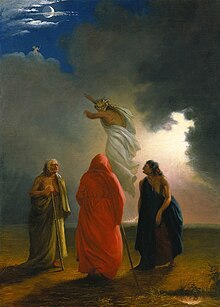 Scene from Macbeth, depicting the witches' conjuring of an apparition in Act 4, Scene I. Painting by William Rimmer | |
| Created by | William Shakespeare |
The Three Witches, too known as the Weird Sisters or Wayward Sisters, are characters in William Shakespeare's play Macbeth (c. 1603–1607). The witches eventually atomic number 82 Macbeth to his demise, and they hold a striking resemblance to the 3 Fates of classical mythology. Their origin lies in Holinshed'due south Chronicles (1587), a history of England, Scotland and Ireland. Other possible sources, bated from Shakespeare, include British folklore, contemporary treatises on witchcraft equally King James 6 of Scotland's Daemonologie, the Witch of Endor from the Bible, the Norns of Norse mythology, and aboriginal classical myths of the Fates: the Greek Moirai and the Roman Parcae.
Shakespeare'southward witches are prophets who hail Macbeth early in the play, and predict his rise to kingship. Upon killing the king and gaining the throne of Scotland, Macbeth hears them ambiguously predict his eventual downfall. The witches, and their "filthy" trappings and supernatural activities, set an ominous tone for the play.
Artists in the eighteenth century, including Henry Fuseli and William Rimmer, depicted the witches variously, as accept many directors since. Some take exaggerated or sensationalised the hags, or take adapted them to dissimilar cultures, as in Orson Welles's rendition of the weird sisters every bit voodoo priestesses.
Origins [edit]

Macbeth'south Hillock, near Brodie Castle, is traditionally identified equally the "blasted heath" where Macbeth and Banquo first met the "weird sisters".
The name "weird sisters" is plant in near mod editions of Macbeth. However, the Starting time Page'due south text reads:
- The weyward Sisters, mitt in manus,
- Posters of the Sea and Country...
In later scenes in the Commencement Folio, the witches are described as "weyward", just never "weird". The modern appellation "weird sisters" derives from Holinshed's original Chronicles.[1] Still, modernistic English spelling was simply starting to go fixed past Shakespeare's time and also the word weird (from Old English wyrd, fate) had connotations beyond the modern common connotation of "eerie". The Wiktionary etymology for weird includes this ascertainment:
- "[The word] was extinct in English by the 16th century. It survived in Scots, whence Shakespeare borrowed it in naming the "Weird Sisters", reintroducing it to English language. The senses "abnormal", "strange", etc. arose via reinterpretation of "Weird Sisters" and date from afterward this reintroduction."
I of Shakespeare's principal sources is the Holinshed (1587)[2] [ full commendation needed ] business relationship of King Duncan. Holinshed described the future King Macbeth of Scotland and his companion Banquo encountering
- "three women in foreign and wild apparell, resembling creatures of elder world" who hail the men with glowing prophecies and and so vanish "immediately out of their sight".[3]
Holinshed reported that
- "the common opinion was that these women were either the Weird Sisters, that is ... the goddesses of destiny, or else some nymphs or fairies endued with knowledge of prophecy past their necromantical scientific discipline."[iii]
Another principal source was the Daemonologie of King James published in 1597 which included a news pamphlet titled Newes from Scotland that detailed the infamous N Berwick witch trials of 1590. Not only had this trial taken identify in Scotland, witches involved confessed to attempt the employ of witchcraft to raise a tempest and sabotage the very boat King James and the Queen of Scots were on board during their return trip from Kingdom of denmark. The 3 witches discuss the raising of winds at sea in the opening lines of Act 1, scene 3.[4]
The news pamphlet states:
- Moreover she confessed that at the time when his Majesty was in Denmark, she existence accompanied with the parties earlier specially named, took a True cat and christened it, and after bound to each office of that Cat, the cheefest parts of a dead man, and several joints of his body, and that in the night following the said Cat was conveyed into the midst of the sea by all these witches sailing in their riddles or Cues as aforesaid, and so left the said Cat right before the boondocks of Leith in Scotland:
- This done, there did ascend such a tempest in the Sea, equally a greater has non been seen, which tempest was the cause of the perishing of a Boat or vessel coming over from the town of Brunt Island to the boondocks of Leith, of which was many Jewels and rich gifts, which should have been presented to the current Queen of Scotland, at her Majesty'southward coming to Leith. Once more it is confessed, that the said christened Cat was the cause that the Male monarch Majesty'south Ship at his coming along of Denmark, had a reverse wind to the rest of his Ships, then being in his company, which thing was most strange and true, as the Rex'south Majesty acknowledges – Daemonologie, Newes from Scotland
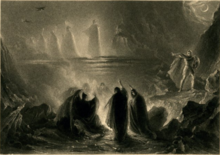
The concept of the 3 Witches themselves may have been influenced by an Former Norse skaldic poem,[5] in which twelve valkyries weave and choose who is to be slain at the Battle of Clontarf (fought outside Dublin in 1014).[vi]
Shakespeare's creation of the 3 Witches may take also been influenced by an anti-witchcraft constabulary passed by King James nine years previously, a police force that was to stay untouched for over 130 years.[seven] His characters' "chappy fingers", "skinny lips", and "beards", for instance, are not found in Holinshed.[8]
Macbeth'south Hillock near Brodie, between Forres and Nairn in Scotland, has long been identified equally the mythical meeting place of Macbeth and the witches.[9] [10] Traditionally, Forres[11] is believed to take been the habitation of both Duncan and Macbeth.[12]
Still, Coleridge proposed that the 3 weird sisters should be seen as cryptic figures, never really calling themselves 'witches', nor are they called 'witches' past other characters in the play. Moreover, they were depicted as more fair than foul both in Holinshed'south account and in the description of a contemporary play-goer Simon Forman.[xiii]
Dramatic part [edit]

The Three Witches first appear in act ane, sc 1, where they hold to meet later with Macbeth. In act 1, sc iii, they greet Macbeth with a prophecy that he shall exist king, and his companion, Banquo, with a prophecy that he shall generate a line of kings. The prophecies have bully impact upon Macbeth. As the audience afterward learns, he has considered usurping the throne of Scotland.
Several not-Shakespearean moments are thought to take been intruded into Macbeth one-time c. 1618; these include all of deed 3, sc five and deed iv, sc 1, ℓℓ 39–43 and ℓℓ 125–132, as well as two songs.[xiv]
- In human action iii, sc 5 (believed to not exist written by Shakespeare)[14] the Witches adjacent announced and are reprimanded past Hecate for dealing with Macbeth without her participation. Hecate orders the trio to besiege at a forbidding place where Macbeth will seek their art.
In act four, sc 1, the Witches gather and produce a serial of ominous visions for Macbeth that herald his downfall. The coming together ends with a "show" of Banquo and his royal descendants. The Witches then vanish.
Analysis [edit]
The Three Witches represent evil, darkness, chaos, and conflict, while their role is as agents and witnesses. They announced to have a warped sense of morality, deeming seemingly terrible acts to be moral, kind or correct, such as helping i another to ruin the journeying of a sailor. Their presence communicates treason and impending doom. During Shakespeare'south day, witches were seen as worse than rebels, "the most notorious traitor and insubordinate that tin exist".[15] They were not only political traitors, simply spiritual traitors besides. Much of the confusion that springs from them comes from their ability to straddle the play's borders betwixt reality and the supernatural. They are so deeply entrenched in both worlds that it is unclear whether they control fate, or whether they are merely its agents. They defy logic, not being subject to the rules of the existent world.[15]
The witches' lines in the first act:
- "Fair is foul, and foul is fair
- Hover through the fog and filthy air"
are oftentimes said to set the tone for the remainder of the play past establishing a sense of moral defoliation. Indeed, the play is filled with situations in which evil is depicted as good, while good is rendered evil. The line "Double, double toil and trouble," (often sensationalised to a point that it loses meaning), communicates the witches' intent conspicuously: they seek only to increment trouble for the mortals around them.[xvi]
Though the witches practise not direct tell Macbeth to impale King Duncan, they use a subtle course of temptation when they inform Macbeth that he is destined to be king. By placing this thought in his mind, they effectively guide him on the path to his own destruction. This follows the pattern of temptation attributed to the Devil in the contemporary imagination: the Devil was believed to be a thought in a person's mind, which he or she might either indulge or turn down. Macbeth indulges the temptation, while Banquo rejects information technology.[16]
Functioning [edit]
Insertions by Davenant [edit]
In a version of Macbeth by William Davenant (1606–1668) a scene was added in which the witches tell Macduff and his wife of their time to come as well as several lines for the two before Macbeth's entrance in act iv. Almost of these lines were taken directly from Thomas Middleton's play The Witch. David Garrick kept these added scenes in his eighteenth-century version.[17]
Walpole's political satire [edit]
Horace Walpole created a parody of Macbeth in 1742 entitled The Dear Witches in response to political problems of his fourth dimension. The witches in his play are played by iii everyday women who manipulate political events in England through marriage and patronage, and dispense elections to have Macbeth made Treasurer and Earl of Bath. In the concluding scene, the witches gather effectually a cauldron and chant "Double, double, Toil and Problem / parties burn and Nonsense bubble." Into their batter they throw such things as "Judgment of a Beardless Youth" and "Liver of a Renegade". The unabridged play is a commentary on the political corruption and insanity surrounding the period.[18]
Welles' "voodoo Macbeth" [edit]
Orson Welles' phase product of Macbeth sets the play in Haiti, and casts the witches as voodoo priestesses. As with earlier versions, the women are bystanders to the murder of Banquo, likewise as Lady Macbeth'south sleepwalking scene. Their role in each of these scenes suggests they were behind Macbeth's fall in a more than direct manner than Shakespeare'due south original portrays. The witches interlope further and further into his domain as the play progresses, appearing in the wood in the first scene and in the castle itself by the terminate. Directors often accept difficulty keeping the witches from being exaggerated and overly-sensational.[nineteen]
Marowitz's and Ionesco's witches' secret identities [edit]
Charles Marowitz created A Macbeth in 1969, a streamlined version of the play which requires only eleven actors. The product strongly suggests that Lady Macbeth is in league with the witches. I scene shows her leading the three to a firelight incantation.
In Eugène Ionesco's satirical version of the play Macbett (1972), 1 of the witches removes a costume to reveal that she is, in fact, Lady Duncan, and wants to be Macbeth'due south mistress. One time Macbeth is King and they are married, however, she abandons him, revealing that she was not Lady Duncan all forth, but a witch. The real Lady Duncan appears and denounces Macbeth as a traitor.[xx]
Felipe's adaption to Castilian [edit]
The Castilian poet and playwright León Felipe wrote a version of Shakespeare's play in Castilian which significantly changes the witches' role, especially in the final scene. After Macbeth's death, the Three Witches reappear in the midst of wind and tempest, which they have been associated with throughout the play, to claim his corpse. They deport it to a ravine and shout, "Macbeth! Macbeth! Macbeth! / We take an appointment with you in Hell!"
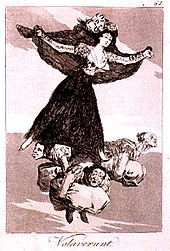
In the play, they as well connect themselves to a painting by Francisco Goya called Volaverunt, in which 3 mysterious figures are flying through the air and supporting a more discernible royal female effigy.[21]
Other representations [edit]
In art [edit]
Drawings independent in Holinshed'south Chronicles, one of the sources Shakespeare used when creating the characters, portray them as members of the upper class. They are wearing elaborate dresses and hairstyles and appear to be noblewomen equally Macbeth and Banquo approach. Shakespeare seems to take diverted quite a bit from this image, making the witches (as Banquo says):
- "withered, and so wild in their attire,
- That await not like th' inhabitants o' th' globe ...
- each at once her choppy fingers laying
- upon her skinny lips. Yous should be women,
- and yet your beards forbid me to interpret
- that you are and so."[viii] [22]
The Three Witches of Macbeth accept inspired several painters over the years who have sought to capture the supernatural darkness surrounding Macbeth'south encounters with them. For example, by the eighteenth century, belief in witches had waned in the United Kingdom. Such things were thought to be the simple stories of foreigners, farmers, and superstitious Catholics. However fine art depicting supernatural subjects was very popular.
- Runciman
John Runciman, as one of the starting time artists to utilise Shakespearean characters in his work, created an ink-on-newspaper drawing entitled The Three Witches in 1767–68. In it, three ancient figures are shown in close consultation, their heads together and their bodies unshown. Runciman's brother created another cartoon of the witches called The Witches show Macbeth The Apparitions painted circa 1771–1772, portraying Macbeth's reaction to the ability of the witches' conjured vision. Both brothers' piece of work influenced many after artists by removing the characters from the familiar theatrical setting and placing them in the earth of the story.[23]
- Füssli
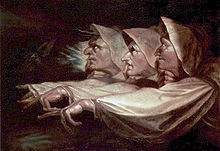

Henry Fuseli would later create one of the more famous portrayals of the Three Witches in 1783, entitled The Weird Sisters or The Three Witches. In it, the witches are lined upwardly and dramatically pointing at something all at once, their faces in contour. This painting was parodied by James Gillray in 1791 in Weird Sisters; Ministers of Darkness; Minions of the Moon. Three figures are lined up with their faces in profile in a way like to Fuseli'due south painting. Withal, the three figures are recognisable as Lord Dundas (the dwelling house secretary at the time), William Pitt (prime government minister), and Lord Thurlow (Lord Chancellor). The three of them are facing a moon, which contains the profiled faces of George III and Queen Charlotte. The cartoon is intended to highlight the insanity of Rex George and the unusual alliance of the three politicians.[23]
Fuseli created 2 other works depicting the Iii Witches for a Dublin art gallery in 1794. The first, entitled Macbeth, Banquo and the Iii Witches was a frustration for him. His earlier paintings of Shakespearean scenes had been done on horizontal canvases, giving the viewer a motion-picture show of the scene that was like to what would have been seen on phase. Woodmason requested vertical paintings, shrinking the space Fuseli had to work with. In this item painting he uses lightning and other dramatic effects to separated Macbeth and Banquo from the witches more clearly and communicate how unnatural their meeting is. Macbeth and Banquo are both visibly terrified, while the witches are confidently perched atop a mound. Silhouettes of the victorious ground forces of Macbeth can be seen celebrating in the groundwork, merely lack of space necessitates the removal of the barren, open landscape seen in Fuseli'due south earlier paintings for the Boydell Shakespeare Gallery of the same scene.[24]

Macbeth and the Armed Head by Fuseli
Fuseli's other Macbeth Woodmason painting Macbeth and the Armed Head depicts a later scene in which Macbeth is shown MacDuff and warned to exist wary of him. Fuseli evidently intended the two paintings to exist juxtaposed. He said, "when Macbeth meets with the witches on the heath, it is terrible, considering he did not expect the supernatural visitation; but when he goes to the cave to ascertain his fate, it is no longer a bailiwick of terror." Fuseli chose to make MacDuff a virtually-likeness of Macbeth himself, and considered the painting 1 of his near poetic in that sense, asking,
- "'What would be a greater object of terror to you if, some dark on going dwelling, y'all were to find yourself sitting at your own table ... would non this make a powerful impression on your mind?"[24]
In music [edit]
- Verdi
At least fifteen operas have been based on Macbeth,[25] only only ane is regularly performed today. This is Macbeth, composed past Giuseppe Verdi to a libretto by Francesco Maria Piave and premièred in Florence in 1847. In the opera, the Three Witches became a chorus of at to the lowest degree eighteen singers, divided into three groups. Each group enters separately at the start of the opera for the scene with Macbeth and Banquo; later the men's divergence, they accept a chorus of triumph which does non derive from Shakespeare. They reappear in act three, when they conjure upwards the iii apparitions and the procession of kings. When Verdi revised the opera for operation in Paris in 1865, he added a ballet (rarely performed nowadays) to this scene. In it, Hecate, a non-dancing grapheme, mimes instructions to the witches earlier a final dance and Macbeth'south inflow.[26]
- Purcell
In Henry Purcell'south opera Dido and Aeneas with libretto by Nahum Tate, the Sorceress addresses the 2 Enchantresses as "Wayward Sisters," identifying the three of them with the fates, as well equally with the malevolent witches of Shakespeare's Macbeth.[27]
In literature [edit]
- Stoker
In Dracula, 3 vampire women who live within in Dracula's castle are often dubbed the "Weird Sisters" by Johnathan Harker and van Helsing, though it's unknown if Bram Stoker intended them to be intentionally quoting Shakespeare. Most media these days simply refer to them equally the Brides of Dracula, probable to differentiate the characters.
- Pratchett
In Wyrd Sisters, a Discworld fantasy novel by Terry Pratchett these three witches and the Earth Theater at present named "The Disc" are featured.
In motion picture [edit]

- Welles
Orson Welles created a film version of the play in 1948, sometimes called the Übermensch Macbeth, which altered the witches' roles by having them create a voodoo doll of Macbeth in the showtime scene. Critics take this as a sign that they control his actions completely throughout the moving-picture show. Their voices are heard, but their faces are never seen, and they behave forked staves as night parallels to the Celtic cross. Welles' voiceover in the prologue calls them "agents of chaos, priests of hell and magic". At the end of the flick, when their work with Macbeth is finished, they cut off the head of his voodoo doll.[28] (pp 129-130)
- Kurosawa
Throne of Claret, a Japanese version filmed in 1958 by Akira Kurosawa, replaces the Three Witches with the Wood Spirit, an old hag who sits at her spinning wheel, symbolically entrapping Macbeth's equivalent, Washizu, in the web of his ain appetite. She lives exterior "The Castle of the Spider'southward Web", another reference to Macbeth's entanglement in her trap.[28] (pp 130-131) Backside her hut, Washizu finds piles of rotting bones. The hag, the spinning wheel, and the piles of basic are straight references to the Noh play Adachigahara (too called Kurozuka), one of many artistic elements Kurosawa borrowed from Noh theatre for the film.
- Polanski
Roman Polanski's 1971 film version of Macbeth contained many parallels to his personal life in its graphic and vehement depictions. His wife Sharon Tate had been murdered two years earlier by Charles Manson and three women. Many critics saw this equally a clear parallel to Macbeth's murders at the urging of the Three Witches within the film.[29]
- Morrissette
Scotland, PA, a 2001 parody film directed by Billy Morrissette, sets the play in a restaurant in 1970s Pennsylvania. The witches are replaced by three hippies who give Joe McBeth drug-induced suggestions and prophecies throughout the film using a Magic eight-Ball. After McBeth has killed his boss, Norm Duncan, 1 of them suggests, "I've got it! Mac should kill McDuff's unabridged family!" Another hippie sarcastically responds, "Oh, that'll work! Maybe a thousand years ago. You lot tin't go around killing everybody."[thirty]
- Coen
In Joel Coen's 2022 flick The Tragedy of Macbeth, British actress Kathryn Hunter plays all three witches. Though mostly depicted as iii personalities inside a single body, there are several instances where the witch divides into three distinct figures. Hunter worked extensively with Coen to develop a physicality for the witches, describing them every bit a intermediate forms, in between human women and crows (crows are also ofttimes shown flying through scenes in the film).[31]
In television [edit]
The Doctor Who episode "The Shakespeare Code" (2007) features the inspiration for the three witches, members of an alien species called the Carrionites. Unlike humans or Time Lords, Carrionite science is based on words instead of numbers, thus their "witchcraft" is really advanced engineering science.
The 2010s Netflix series Chilling Adventures of Sabrina depicts 3 teenage witches named Prudence, Agatha, and Dorcas, who are referred to as the Weird Sisters.
In computer games [edit]
In the computer game The Witcher 3: Wild Hunt (2015), the Three Crones of Crookback Bog make an appearance, referred to every bit the "ladies of the wood" or "the good ladies", called Whispess, Brewess and Weavess. Portrayed equally erstwhile, grossly deformed women who wield aboriginal, powerful magic, they are malicious characters, able to shapeshift, and pose challenges to the game'south protagonists. Within the showtime one-half of the game, they confront the titular effigy with a prophecy most his ill fate, hinting at the outcome of the game if the player fails at the overarching quest.
Influence [edit]
- Beckett
Come and Go, a short play written in 1965 by Samuel Beckett, recalls the Three Witches. The play features only three characters, all women, named Flo, Half dozen, and Ru. The opening line: "When did nosotros three last meet?"[32] recalls the "When shall nosotros three meet again?" of Macbeth act i, sc 1.[33]
- Reisert
The 3rd Witch, a 2001 novel written by Rebecca Reisert, tells the story of the play through the eyes of a young girl named Gilly – one of the witches. Gilly seeks Macbeth'south expiry out of revenge for killing her father.[34]
- Rowling
J. Chiliad. Rowling has cited the Three Witches equally an influence in her Harry Potter series. In an interview with The Leaky Cauldron and MuggleNet, when asked, "What if [Voldemort] never heard the prophecy?", she said, "Information technology'southward the 'Macbeth' idea. I absolutely admire 'Macbeth'. It is peradventure my favourite Shakespeare play. And that's the question isn't it? If Macbeth hadn't met the witches, would he have killed Duncan? Would whatever of it have happened? Is it blighted or did he make it happen? I believe he made it happen."[35] On her website, she referred to Macbeth again in discussing the prophecy: "the prophecy (like the one the witches brand to Macbeth, if anyone has read the play of the same name) becomes the catalyst for a situation that would never have occurred if it had not been fabricated."[36]
The soundtrack to the third Harry Potter film features a song by John Williams called "Double Problem", a reference to the witches' line, "Double double, toil and problem". The lyrics were adapted from the Three Witches' spell in the play. More playfully, Rowling also invented a musical band popular in the Wizarding earth called The Weird Sisters that appears in passing in several books in the series as well as the film adaptation of Harry Potter and the Goblet of Burn down.
Run into also [edit]
- Baba Yaga, who can manifest herself as a trio of identical figures
- Les Lavandieres, the Night Washerwomen of Celtic mythology
- Triple Goddess
References [edit]
- ^ Urmson, J.O. (1981). "Tate'due south 'Wayward Sisters'". Music & Letters. 62 (ii): 245.
- ^ Holinshed, R. (1587). The Chronicles of England, Scotland, and Ireland.
- ^ a b Nicoll, Allardyce; Muir, Kenneth (2002). Shakespeare Survey. Cambridge University Press. p. 4. ISBN0-5215-2355-9.
- ^ Warren, Brett (14 May 2016). The Annotated Daemonology of Rex James. A critical edition in modern English. p. 107. ISBN978-1-5329-6891-4.
If this sounds familiar, Shakespeare took inspiration from this very passage and applied the same methods of witchcraft to his play Macbeth just a few years after the publication of Dæmonologie. All of the inhabitants of England and Scotland would take been familiar with this case and as the play of Macbeth is also set in Scotland, many quotes from King James' dissertation are taken equally inspiration.
- ^ "Njáls saga". Darraðarljóð. affiliate 157.
- ^ Simek, R. (2007). Dictionary of Northern Mythology. Translated by Hall, Angela. Woodbridge, Uk: D.S. Brewer. p. 57. ISBN0859915131.
- ^ Tolman, Albert H. (1896). "Notes on Macbeth". Publications of the Modernistic Language Association. 11 (2): 200–219. doi:10.2307/456259. JSTOR 456259.
- ^ a b "Witches: Those well-dressed women are witches?". Internet Shakespeare Editions. University of Victoria and the Social Sciences and Humanities Inquiry Council of Canada. Retrieved 10 May 2008.
- ^ "Hail, Macbeth, savoiur of Scots tourism". The Scotsman. seven October 2014.
- ^ Shaw, Lachlan; Gordon, James Skinner (1882). The History of the Province of Moray: Comprising the counties of Elgi Nairn, the greater office of the Canton of Inverness and a portion of the County of Banff, all chosen the Province of Moray before there was a division into counties. Vol. two. London, UK: Hamilton, Adams. pp. 173–174, 218–219 – via Internet Archive (archive.org).
- ^ Forres. ordnancesurvey.co.united kingdom of great britain and northern ireland (map).
- ^ Ayto, John; et al. (2005). Brewer's Britain & Ireland. London, UK: Weidenfeld & Nicolson. p. 435. ISBN9780304353859.
- ^ Bate, Jonathan. "The Case for the Folio" (PDF). rscshakespeare.co.uk. pp. 34–35.
- ^ a b Evans, G. Blakemore, ed. (1974). The Riverside Shakespeare. Boston, MA: Houghton and Mifflin. pp. 1340–1341.
- ^ a b Coddon, Karin S. (Oct 1989). "'Unreal Mockery': Unreason and the problem of spectacle in Macbeth". ELH. 56 (three): 485–501.
- ^ a b Frye, Roland Mushat (July 1987). "Launching the Tragedy of Macbeth: Temptation, deliberation, and consent in act I". The Huntington Library Quarterly. 50 (three): 249–261.
- ^ Fiske, Roger (April 1964). "The Macbeth music". Music & Letters. 45 (2): 114–125.
- ^ Alexander, Catherine Chiliad.S. (May 1998). "The Dear Witches: Horace Walpole'south Macbeth". The Review of English Studies. 49 (194): 131–144.
- ^ McCloskey, Susan (Jan 1985). "Shakespeare, Orson Welles, and the 'voodoo' Macbeth". Shakespeare Quarterly. 36 (4): 406–416.
- ^ Rozett, Martha (1994). Talking Back to Shakespeare. Newark: University of Delaware Printing. pp. 127–131. ISBN087413529X.
- ^ Kliman, Bernice; Santos, Rick (2005). Latin American Shakespeares. Madison: Fairleigh Dickinson Academy Press. pp. 103–105. ISBN0838640648.
- ^ Shakespeare, Westward. The Tragedy of Macbeth. deed 1, scene three, lines 39–47.
- ^ a b "Room 5: Witches and apparitions" (Museum exhibit). Gothic nightmares: Fuseli, Blake, and the romantic imagination. Tate U.k. Art Museum. Archived from the original on thirty April 2008. Retrieved 10 May 2008.
- ^ a b Hamlyn, Robin (Baronial 1978). "An Irish gaelic Shakespeare gallery". The Burlington Magazine. Vol. 120, no. 905. pp. 515–529.
- ^ Sadie, Due south., ed. (1992). The New Grove Dictionary of Opera. Vol. four. Oxford, United kingdom of great britain and northern ireland: Oxford University Press. p. 344. ISBN978-0-19-522186-2.
- ^ Budden, J. (1973). The Operas of Verdi. Vol. 1. London, U.k.: Cassell. pp. 277, 300–302. ISBN0-304-93756-8.
- ^ "Dido and Aeneas" (libretto). Palo Alto, CA: Stanford University.
- ^ a b Jackson, Russell (2007). The Cambridge Companion to Shakespeare on Film. Cambridge, UK: Cambridge University Press. pp. 129–131. ISBN052168501X.
- ^ Holland, Peter (2004). Shakespeare Survey: An almanac survey of Shakespeare studies and production. Cambridge, UK: Cambridge Academy Press. pp. 145–146. ISBN0521841208.
- ^ Leitch, Thomas (2007). Flick Adaptation and its Discontents. Baltimore, MD: The Johns Hopkins University Press. pp. 117–118. ISBN0801885655.
- ^ Lenker, Maureen Lee (14 January 2022). "The Tragedy of Macbeth: Kathryn Hunter on conjuring a new take on Shakespeare'southward three witches". Entertainment Weekly . Retrieved 2 March 2022.
- ^ Beckett, Due south. (1984). "Come and Get". Collected Shorter Plays of Samuel Beckett. London, United kingdom of great britain and northern ireland: Faber and Faber. p. 196.
- ^ Beckett, Southward. (2006). Roche, A. (ed.). Samuel Beckett: The Great Plays after Godot / Samuel Beckett – 100 Years. Dublin, IE: New Island. p. 69.
- ^ Reisert, Rebecca (2001). The Third Witch: A novel. New York, NY: Washington Foursquare Press. ISBN0-7434-1771-ii.
- ^ "The Leaky Cauldron and MN interview Joanne Kathleen Rowling". The Leaky Cauldron. 28 July 2007. Retrieved 8 February 2022.
- ^ "What is the significance of Neville being the other male child to whom the prophecy might take referred?". J.K.Rowling official site (jkrowling.com). Archived from the original on 5 February 2012. Retrieved 26 June 2007.
Sources [edit]
- Bloom, Harold, 1987. William Shakespeare's Macbeth. Yale University: Chelsea House.
- Bernice West, Kliman, 200. Macbeth. Manchester: Manchester University Printing, 2nd rev ed. ISBN 0-7190-6229-ii
- Shakespeare, William; Cross, Wilbur Lucius (Ed); (2007). Macbeth. Forgotten Books.
External links [edit]
- Macbeth: Full-text online
Source: https://en.wikipedia.org/wiki/Three_Witches
0 Response to "1896 When Shall We Three Meet Again"
Post a Comment